.png?width=165&height=30&name=rocksalt-horizontal-rose-icon%20(1).png)
Executive Summary
This report distills 12 months of B2B marketing influencer discourse into three things CMOs and heads of marketing can act on: where your content and thought leadership energy is being wasted, how to reframe your work for internal stakeholders, and where white space exists for your brand to own a narrative.
Three things this data shows:1. Your team is probably over-investing in topics audiences don’t reward (paid ads, attribution theory, generic SEO) and under-investing in topics they actively seek out (PLG case studies, content strategy, pipeline frameworks). 2. The vocabulary your peers use to defend budgets has shifted dramatically. “Brand building” dropped 79%. “Pipeline” rose 21%. The work hasn’t changed but the language that keeps the budget has. 3. There are high-demand, low-supply topics where a well-executed point of view will earn outsized attention because almost nobody else is doing it well. |
1. Where to Redirect Your Content Energy
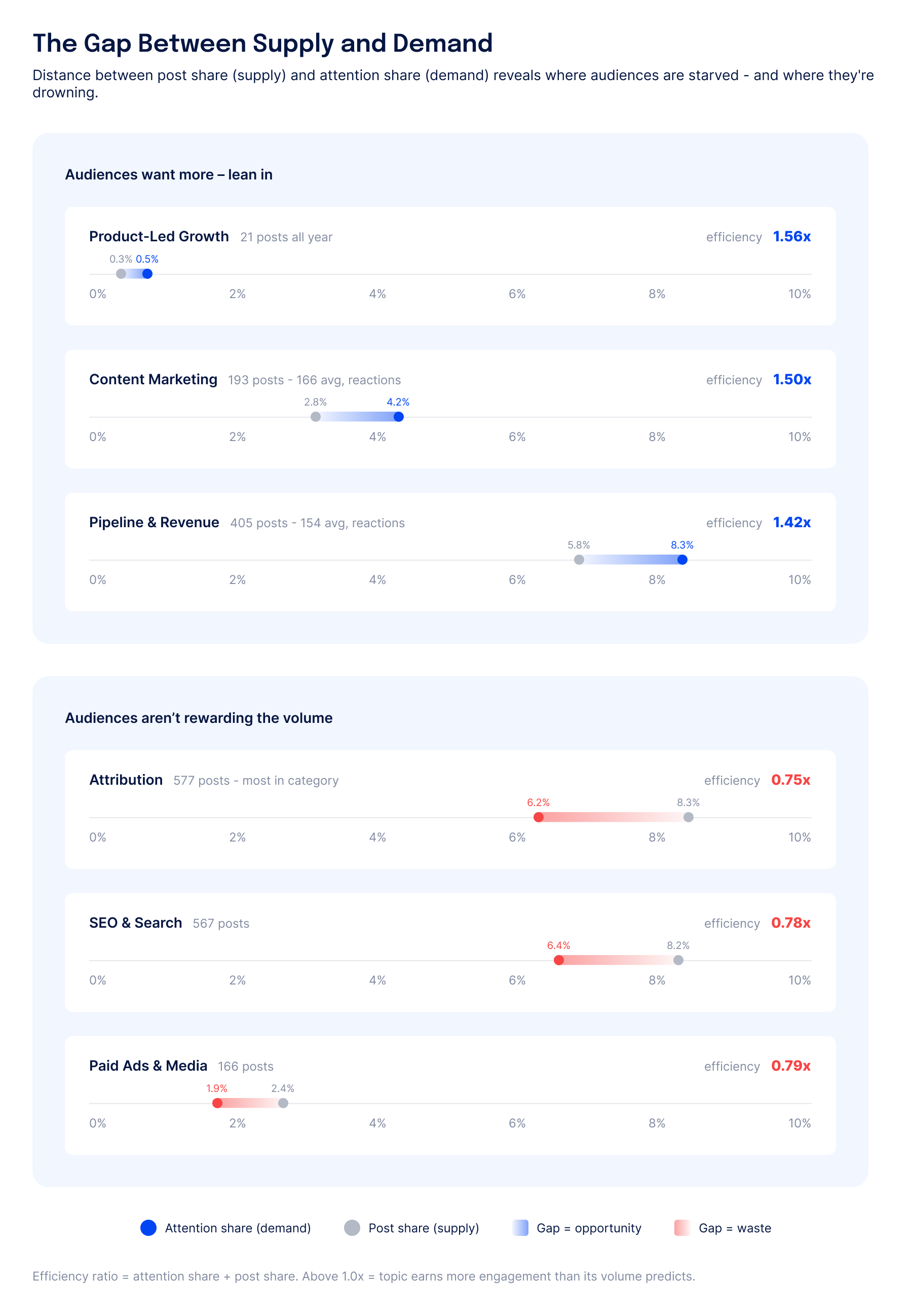
The data reveals a clear gap between what gets posted and what gets rewarded. Some topics are “pushed” by influencers (high post volume, low engagement). Others are “pulled” by audiences (low volume, disproportionate engagement). This gap is directly relevant to how you allocate your team’s content and thought leadership efforts.
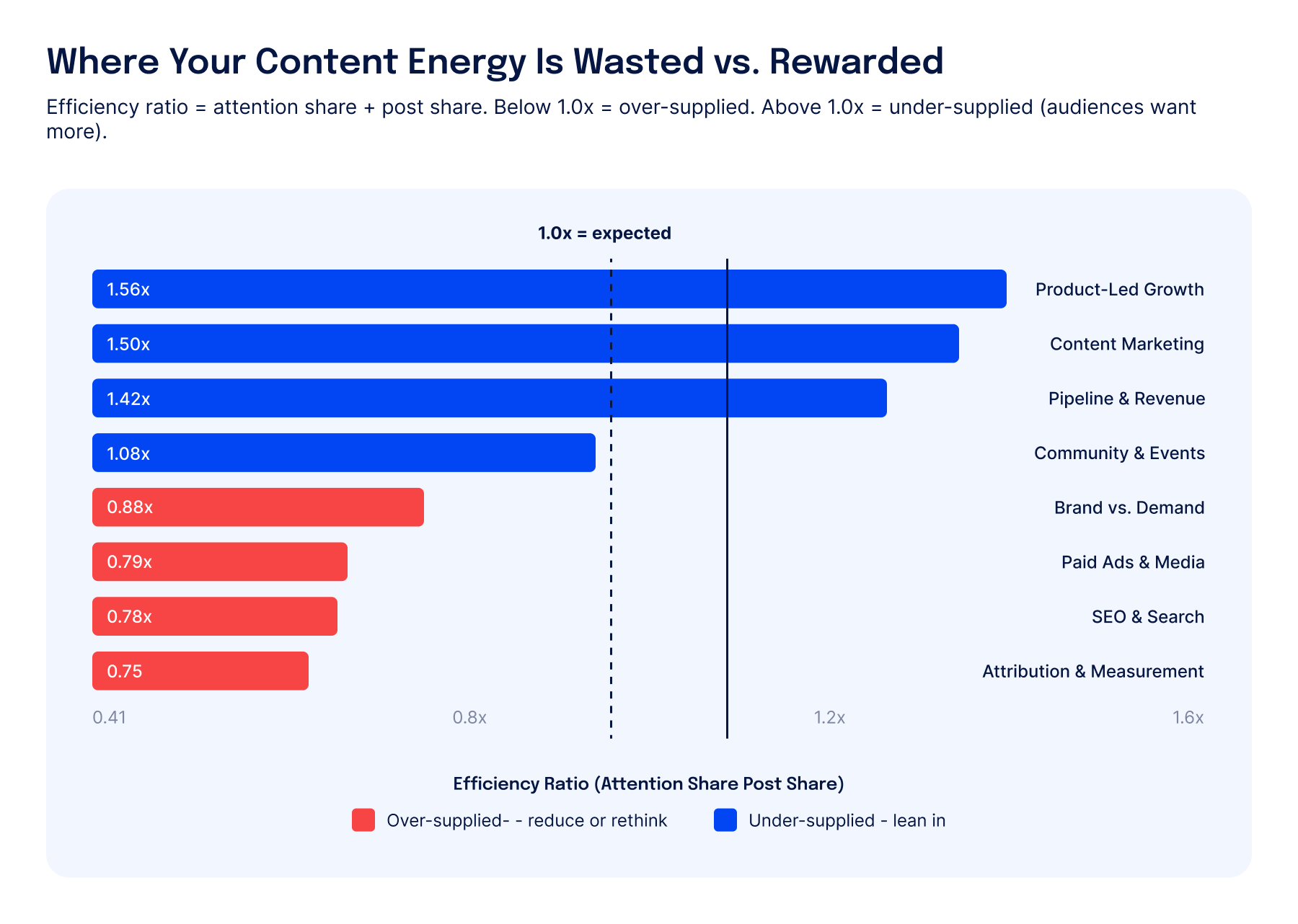
Over-Supplied: Reduce or Rethink
|
Topic |
Post Share |
Attention Share |
Efficiency |
What’s Happening |
|
Paid Ads & Media |
2.4% |
1.9% |
0.79x |
Posted at 1.3x the rate it earns engagement. Driven by influencers selling media buying services, not by audience demand. |
|
Attribution & Measurement |
8.3% |
6.2% |
0.75x |
577 posts—the highest count among pushed topics. Discussions have become too theoretical and disconnected from implementation reality. |
|
SEO & Search |
8.2% |
6.4% |
0.78x |
General SEO advice no longer resonates. The topic has fragmented into niches (technical SEO, GEO) where generic posts feel stale. |
Under-Supplied: Lean In
|
Topic |
Post Share |
Attention Share |
Efficiency |
Why It’s Working |
|
Product-Led Growth |
0.3% |
0.5% |
1.56x |
Only 21 posts all year across 38 influencers, yet each earned 169 reactions—the highest per-post rate in the dataset. |
|
Content Marketing |
2.8% |
4.2% |
1.50x |
193 posts averaging 166 reactions each. Audiences reward strategic depth over tactical quick-wins. |
|
Pipeline & Revenue |
5.8% |
8.3% |
1.42x |
Both rising and pulled—a rare combination. 405 posts averaging 154 reactions. Genuine practitioner demand. |
Quick note on what Efficiency means in this report
Efficiency here simply means: are you getting back more attention than the topic deserves based on how often it gets posted? It is calculated by dividing % of engagement that topic received by % of posts on that topic
- Efficiency ratio = attention share / post share.
- Pushed = efficiency < 0.9. (It's getting less attention from the audience)
- Pulled = efficiency > 1.1. (It's getting more attention from the audience)
What this means for your resource allocationThe over-supplied topics aren’t necessarily wrong to cover—but generic takes on attribution, SEO, and paid media are earning diminishing returns. If your team is producing content in these areas, it needs to be anchored in proprietary data or specific implementation experience. The under-supplied topics earn outsized attention precisely because they’re hard to do well: PLG requires real case studies with numbers, content marketing requires genuine narrative skill, and pipeline frameworks require transparent attribution. The difficulty is the moat. |
2. How to Reframe Your Work Internally
The language of B2B marketing shifted dramatically in 2025. This isn’t semantic drift—it’s a profession adjusting to new evaluative criteria. Understanding which terms are gaining and losing traction tells you how to position your budget conversations, board updates, and cross-functional communications.
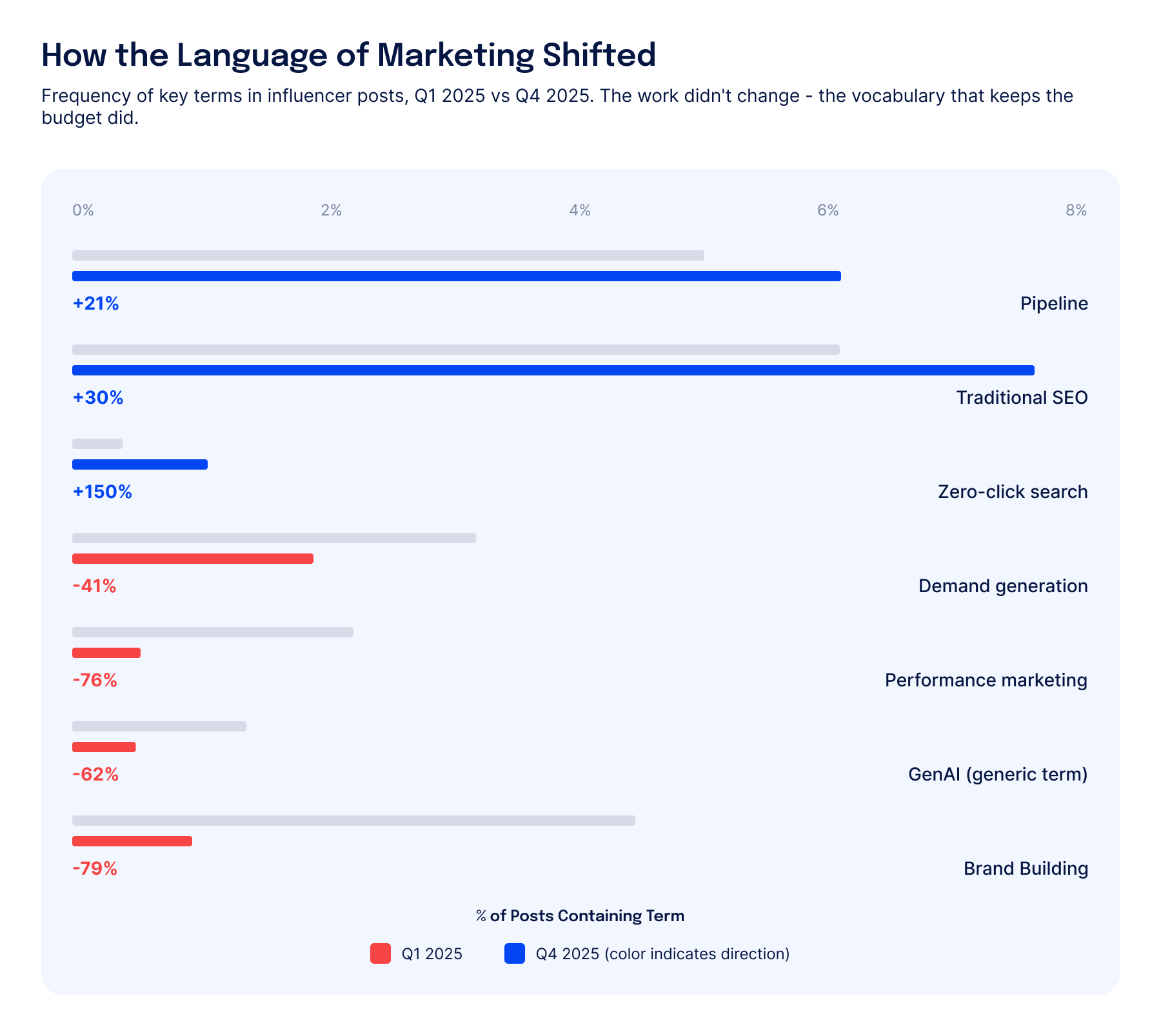
Terms Losing Ground
|
Term |
Q1 2025 |
Q4 2025 |
Change |
|
Brand building |
4.2% |
0.9% |
-79% |
|
GenAI (as generic term) |
1.3% |
0.5% |
-62% |
|
Demand generation |
3.0% |
1.8% |
-41% |
|
Performance marketing |
2.1% |
0.5% |
-76% |
Terms Gaining Ground
|
Term |
Q1 2025 |
Q4 2025 |
Change |
|
Pipeline (as marketing metric) |
4.7% |
5.7% |
+21% |
|
Zero-click search |
0.4% |
1.0% |
+150% |
|
Traditional SEO |
5.7% |
7.4% |
+30% |
|
Specific AI tools (ChatGPT, Claude) |
Rising |
Replaced “GenAI” |
Normalized |
What this means for you:“Brand building” didn’t disappear as an activity—it became politically difficult to name when budgets are scrutinized quarterly. The work continues under different labels: thought leadership, community, content marketing. “Pipeline” didn’t replace brand—it’s what you call brand work when your CFO is listening. Similarly, “GenAI” as a standalone concept evaporated—replaced by references to specific tools. This is what normalization looks like: AI stopped being a category and became infrastructure. The practical implication: when you present to the board or to finance, frame your long-term work in the vocabulary that’s currently defensible. The rise of “zero-click search” also signals a real threat worth naming internally—platforms answering queries without sending traffic challenges the entire content-to-lead funnel. |
3. Where the White Space Is
The highest-efficiency topics in this dataset are areas where audience appetite dramatically exceeds supply. These are not undiscovered topics—they’re difficult topics. The scarcity is the opportunity.
|
Topic |
Posts (12 months) |
Avg. Reactions/Post |
Efficiency Ratio |
Why It’s Hard |
|
Product-Led Growth |
21 |
169 |
1.56x |
Requires operational experience with real numbers. Most people with that experience are running companies, not posting. |
|
Content Marketing |
193 |
166 |
1.50x |
Requires genuine narrative craft. Audiences can distinguish between strategic thinking and repackaged advice. |
|
Pipeline & Revenue |
405 |
154 |
1.42x |
Requires transparent attribution and willingness to share what didn’t work, not just wins. |
What this means for your brand narrativeThese topics earn outsized attention because the bar for credibility is high and few clear it. Generic takes won’t work. But if your company has genuine PLG experience, a distinctive content philosophy, or honest pipeline data you’re willing to share, including what failed, you’re entering a conversation with almost no competition and significant audience demand. |
Wrapping it up
B2B marketing is not abandoning strategy but it is being forced to prove its economic value in real time.
As AI matures, budgets tighten, and buying committees become more self-directed, attention is shifting toward what is measurable, actionable, and revenue-led. The language of marketing is becoming operational not because brand no longer matters, but because credibility now requires translation into business impact.
The influencers who shaped B2B discourse this year were, in many cases, selling their own expertise. Your job isn't to follow their agenda. It's to read the demand signal underneath it — and invest where your audience is hungry and the field is empty.
About the Methodology
6,956 LinkedIn posts from 38 B2B marketing influencers were analyzed over 12 months (January 2025 – January 2026). Posts were classified into 16 topics using keyword matching. Engagement (reactions) was used as the primary attention metric; impressions data was not available. Metrics were aggregated at the influencer level to avoid bias from high-volume posters.
Key definitions:
- Efficiency ratio = attention share / post share.
- Pushed = efficiency < 0.9.
- Pulled = efficiency > 1.1.
Limitations: This reflects influencer discourse, not practitioner sentiment. Reactions proxy for attention, not reach. Topic classification is rule-based and may miss nuance. Correlations are not causal.
Influencer List
Carilu Dietrich, Christopher Penn, Davang Shah, Dave Gerhardt, Elena Verna, Emily Kramer, Finn Thormeier, Joe Chernov, Jon Miller, Justin Rowe, Kathleen Booth, Kevin Indig, Kieran Flanagan, Kyle Poyar, Lee Odden, Liam Moroney, Lisa Cole, Liza Adams, Louis Grenier, Madhav Bhandari, Matt Heinz, Nicole Leffer, Peep Laja, Peter Caputa, Pierre Herubel, Rand Fishkin, Richard King, Sara McNamara, Tas Bober, Tim Davidson, Udi Ledergor, zoë hartsfield
End of Report
This analysis reflects patterns observable in the dataset and should be interpreted as directional insights within this specific influencer ecosystem, not universal truths about B2B marketing. Organizations should validate findings against their own audience data and market context before making strategic decisions.