.png?width=165&height=30&name=rocksalt-horizontal-rose-icon%20(1).png)
Introduction
Much of the guidance on how to optimize your LinkedIn posts to get greater reach suffers from two flaws:
-
Posts combine people with very different audiences. What is good engagement for one person may be quite poor for another because they have different follower counts and different average engagement. So controlling for the audience that a post author has is crucial to isolating what drives post performance.
-
Posts are not segmented for different goals: top-, middle- and bottom-of-funnel. This is critical because different post types are designed to have different levels of engagement but these don't always correlated to business outcomes.
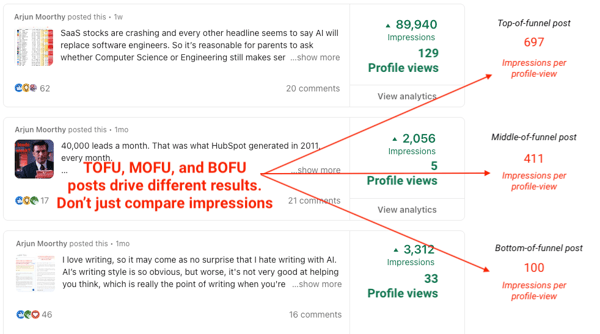
For example, below is a snapshot of my data (Arjun Moorthy) of 3 different posts that show how profile views, which are deeper in the buyer journey, aren't in the same proportion to impressions and engagement that my TOFU, MOFU, and BOFU posts received. In fact, my BOFU post here did the best with 100 impressions/profile-view.
The Rocksalt data science team addresses these two limitations in this analysis and debunks much of the common guidance bandied about today.
Full data source provided for those that want to replicate or try different analysis.
Executive Summary
This analysis of 6,753 LinkedIn posts from 31 B2B marketing influencers surfaces seven data-driven findings that challenge conventional LinkedIn advice.
The content mix that works:
-
Top influencers split their posts roughly 50% marketing-specific (MOFU), 30% personal/general (TOFU), and 20% company-promotion (BOFU). Most executives over-index on self-promotion — this data suggests that's a mistake.
What actually drives engagement
-
Ditch hashtags and links. Top-performing posts use 75% fewer hashtags. Outbound links suppress reach — except in company-promotion posts where they help.
-
Use lists and white space. Top posts contain 4–7x more list-formatted items and more paragraph breaks. Structured, scannable content consistently wins.
-
Personal posts aren't the engagement silver bullet. Contrary to popular belief, median engagement is nearly identical across TOFU, MOFU, and BOFU post types.
What doesn't matter as much as you think
-
Posting more often hurts. Above roughly 1-2 posts per week, engagement may decline. Avoid reposting too much and don't post frequently because you think you'll see progressively increasing engagement.
-
Follower count is not a reliable predictor of engagement. Accounts under 50K followers tend to have similar engagement, while accounts over 50K vary widely.
-
Everyone has bad posts. Even top influencers see a 10x–180x gap between their best and worst posts. Variance is normal — don't optimize for any single post.
On the 2026 LinkedIn algorithm change:
-
360Brew's impact is real but not catastrophic. 8 of 14 influencers saw modest MOFU engagement declines year-over-year. Those with consistent, high-quality content held steady.
The takeaway: write less, write better, skip the hashtags.
1. Influencers utilize a mix of content to be interesting
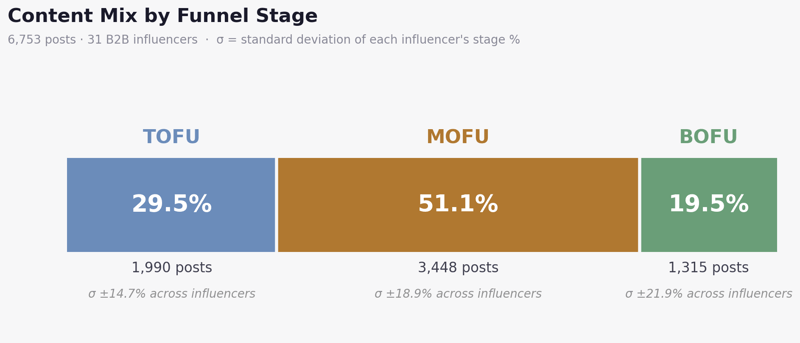
Definitions:
-
BOFU: Company specific content. For this research that is rule-based — if the post text contains the influencer's company name
-
MOFU: Industry specific content. Here we looked at keyword pattern matching across ~50 marketing-specific terms (demand gen, ABM, SEO, pipeline, ICP, funnel, B2B, SaaS, analytics, etc.)
-
TOFU: Everything else — personal takes, general observations, career stories
Anecdotally, what we see with Rocksalt AI customers is most executives write about their company and product too much. This makes them boring. It's important to mix up your writing with the above ratios.
2. Engagement is NOT highest on TOFU posts
Contrary to the popular belief "posts with a personal photo get the most engagement", posts of different types have similar median engagement.
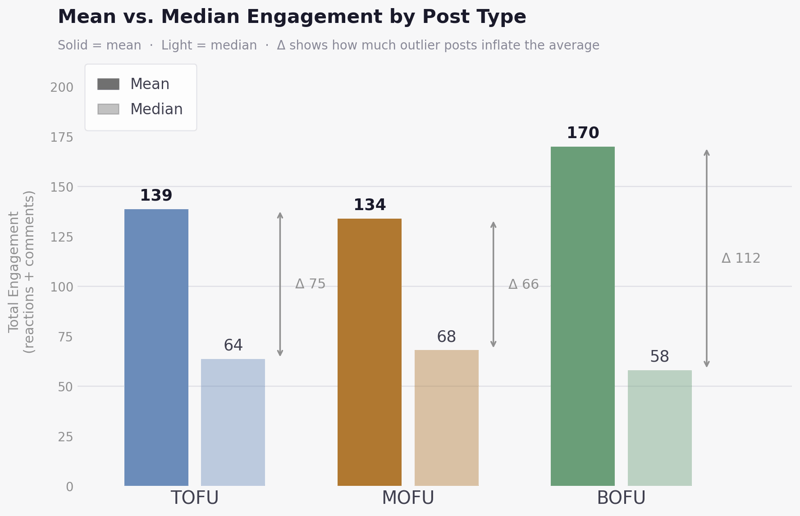
We don't have impressions data for posts so it's quite possible that TOFU posts -- those with photos -- still get the most impressions but average engagement is actually highest in BOFU posts.
Still, given the medians being so close, the main conclusion really is not to assume that personal posts perform the best.
And if you're writing to drive business results then one clue is to look at which posts drive profile views. Profile views are lower in the buyer journey so ultimately this may be a more important metric to optimize than impressions or engagement.
Want to get a free LinkedIn content audit for yourself?Book a 20-min call
|
3. Don't feel bad when your posts don't do well
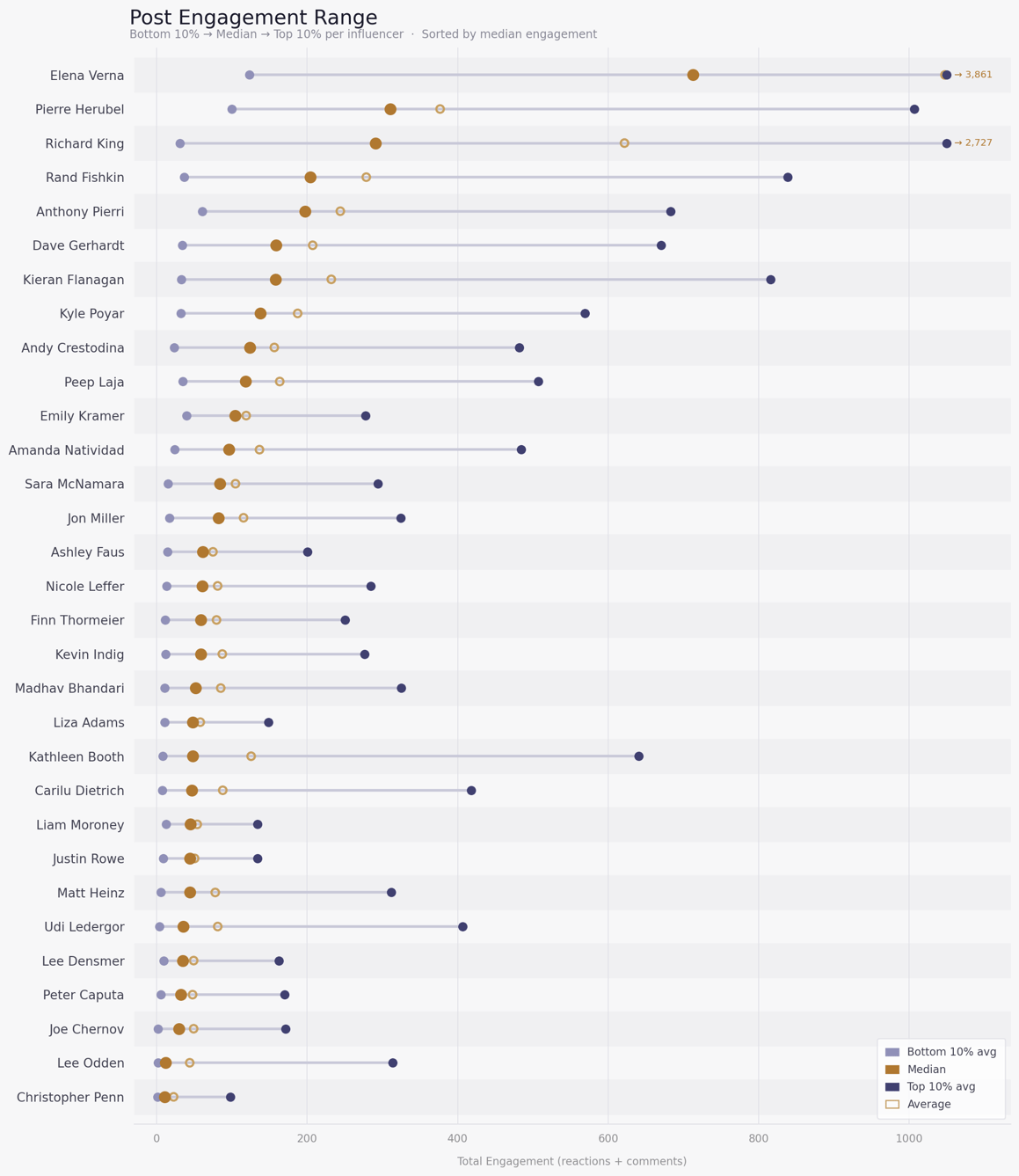
Even world-class influencers sees a wide range of engagement on their posts, from 10x to 180x difference between their best and worst posts!
So we shouldn’t feel bad when some posts don’t get much engagement; that’s normal and part of learning what resonates with your audience, what your expertise really is, and accepting the randomness of what's also trending on LinkedIn the day you post.
4. Links, hashtags, lists, and more - what structural elements correlate with performance
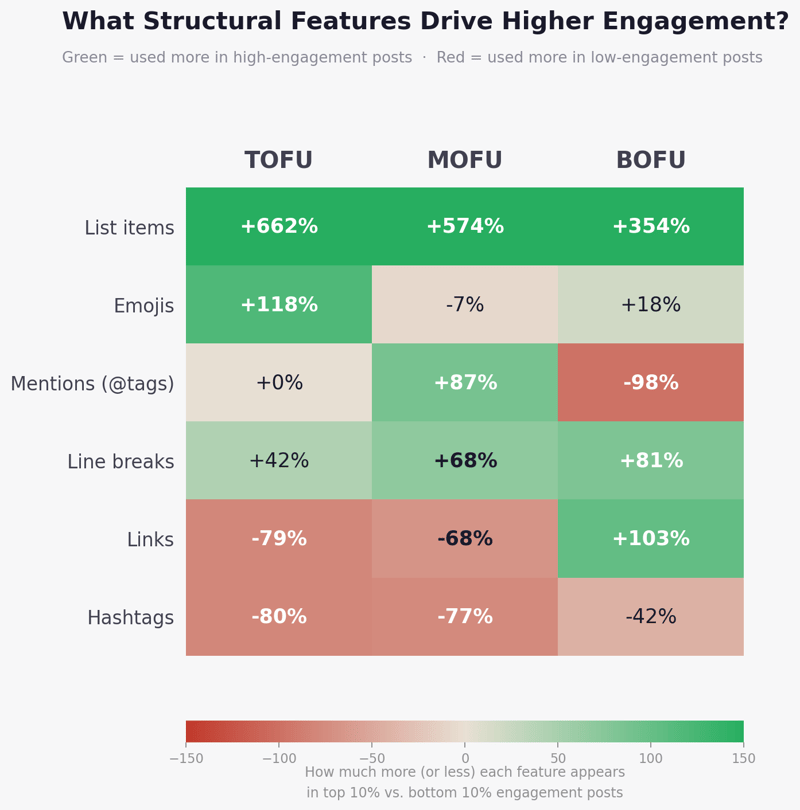
Findings:
-
Links hurt (except in BOFU) — adding links tanks engagement in TOFU and MOFU (likely LinkedIn's algorithm suppressing posts with outbound links). Interestingly, links help in BOFU (+103%) — probably because high-intent product posts with CTAs are shared more deliberately.
-
Hashtags hurt — top performers use ~75% fewer hashtags across TOFU and MOFU. This is one of the strongest signals in the data. Hashtag-heavy posts consistently underperform.
-
Lists dramatically outperform — across all three stages, top posts have 4-7x more list-formatted items. Structured, scannable content wins.
-
More line breaks = better — top posts are more "airy" and broken into short paragraphs. +42% in TOFU, +68% in MOFU, +81% in BOFU.
-
Longer posts win — modestly but consistently, top posts run ~25-50 words longer across all stages.
-
Emojis help in TOFU (+118%) but are essentially neutral in MOFU/BOFU — they signal personality in personal posts but don't move the needle in tactical content.
-
At-mentioning someone, which our dataset shows in BOFU posts mainly, results in 98% worse performance. Don't do it unless you're giving credit to someone as a reference or source of information.
Want to create posts in your voice that doesn't sound AI generated?Try creating one now in 3-minutes flat
|
5. Posting more than 1-2x/week is unnecessary
Conventional wisdom is that posting more often is better and essentially you can't post often enough. This appears to be false.
In fact, posting more than 1x/week may be negatively correlated with average engagement.
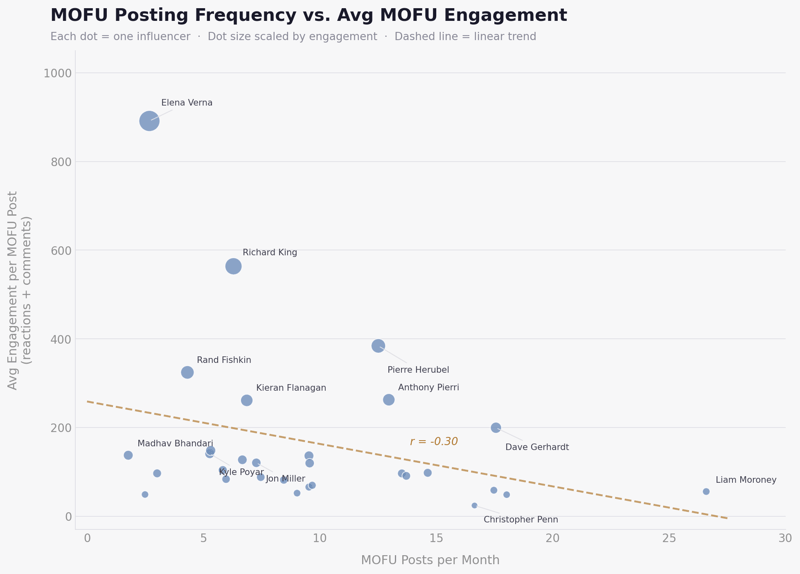
To keep this a bit more comparable on content type we looked only at MOFU posts and MOFU engagement above, but even combining all posts for each influencer doesn't change the story beyond inflating the numbers slightly to suggest that posting ~2x/week is probably enough:
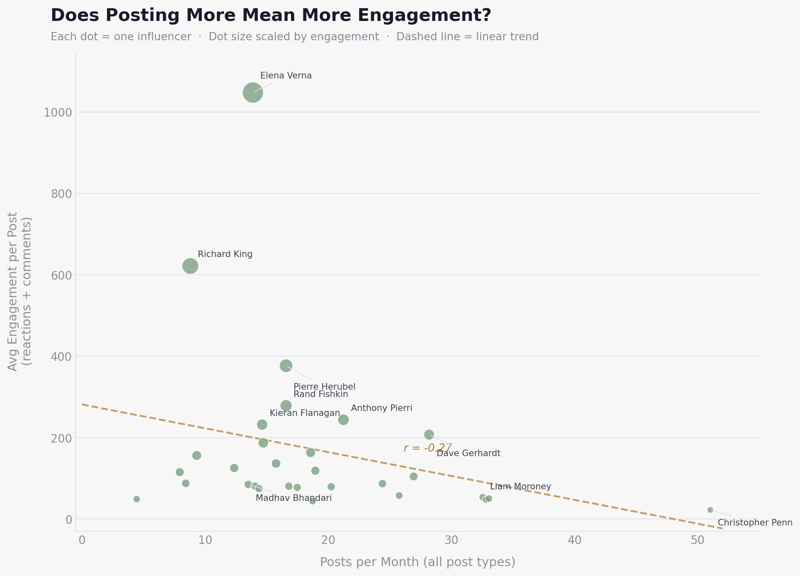
Note that excluding reposts reduces the correlation certainty. The relationship continues to appear negative but not statistically significant (p=0.1).
This suggests, at the very least, two things:
-
Reposts are largely a bad idea, unless perhaps you're adding a lot of your own context.
-
More posting does not lead to higher engagement progressively.
Update: LinkedIn itself says "LinkedIn tends to have higher “fatigue” than other social networks, meaning your audience might not wanna see your face / brand as often as they do on other social networks."
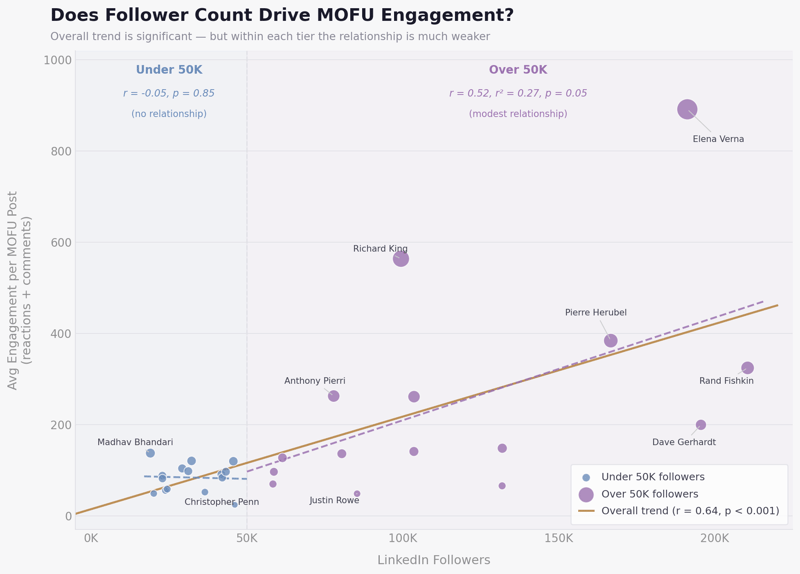
6. Follower count is not a reliable predictor of engagement.
At first glance, follower count appears to strongly predict engagement (r = 0.64 overall) — but this is misleading.
The relationship is driven by a gap between two clusters: accounts under 50K followers have consistently low engagement regardless of their exact follower count (r = -0.05, no relationship), while accounts over 50K show a modest but real correlation (r = 0.52, r² = 0.27).
The practical takeaway for most executives, who sit under 50K followers, is that growing your follower count won't move the needle — content quality matters far more.
7. Modest impact of LinkedIn 360Brew algorithm in 2026.
In 2025, the LinkedIn data science team published a paper about a new AI-powered algorithm called 360Brew which was better at selecting posts for a user's feed. While many have speculated about the impact of this algorithm going live in late 2025 we decided to study what impact it was having on engagement.
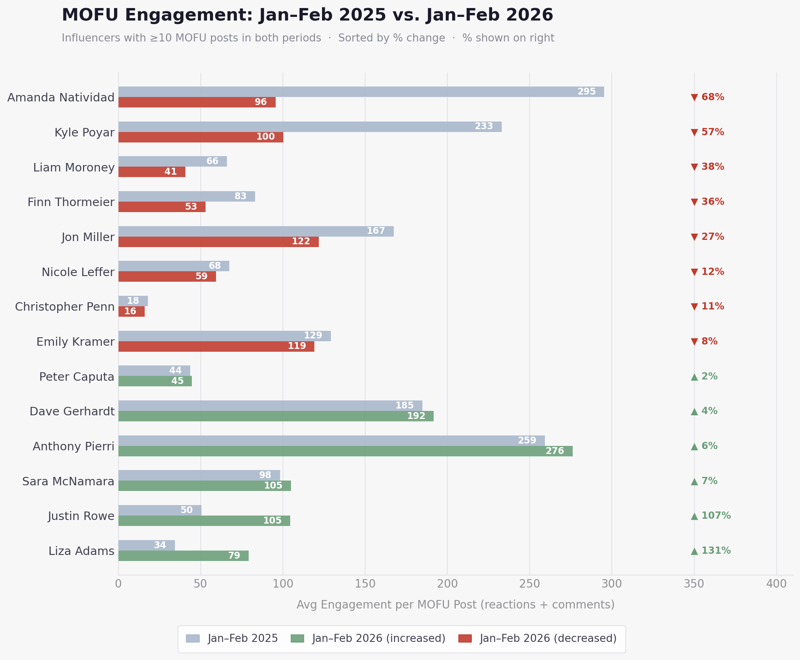
We isolated influencers who had at least 10 MOFU posts in each of two time periods: Jan-Feb 2025 and Jan-Feb 2026, so there were sufficient data points. What we found:
-
The majority declined — 8 of 14 saw lower MOFU engagement in Jan-Feb 2026 vs. Jan-Feb 2025, suggesting getting traction with marketing-specific content on LinkedIn is getting harder overall
-
The bright spots are modest — the two big improvers, Liza Adams (+131%) and Justin Rowe (+107%), started from low bases (34 and 50 avg engagement in 2025), so the absolute gains are smaller than they look
-
The steady performers — Anthony Pierri, Dave Gerhardt, and Sara McNamara held roughly flat, suggesting consistent voice and content quality can maintain engagement even in a tougher environment
In short: yes it may be a bit harder to get engagement in 2026 but there isn't a widespread decline if your content is high quality, as is often the case with the influencers studied here. Keep calm and carry on with posting insightful content.
Methodology
This analysis was a combination of direct mathematical calculations (spreadsheet formulas) and AI-powered exploration. Given AI's hallucination tendency, the analysis was repeated with two different AI providers - Claude Sonnet 4.6 and chatGPT 5.2 - while checking intermediate results via csv exports. The raw data set is provided for anyone who wishes to repeat the analysis or extend it on their own.
We selected this dataset for two reasons:
-
Influencers, loosely defined here as people with more than 10,000 followers, get more engagement than a random sample of LinkedIn users. This allows for more variability in the data and hence a more insightful analysis. We further filtered the 38 we started with down to 31 by selecting only those that had at least 50 posts in the dataset.
-
By keeping influencers in the same category -- marketing in this case -- we reduce the variability introduced by having content in different industries as some of these will have different amounts of their audiences on LinkedIn.
Influencer List
Jon Miller, Rand Fishkin, Amanda Natividad, Peter Caputa, Dave Gerhardt, Madhav Bhandari, Matt Heinz, Kevin Indig, Ashley Faus, Christopher Penn, Andy Crestodina, Anthony Pierri, Udi Ledergor, Peep Laja, Richard King, Lee Odden, Pierre Herubel, Lee Densmer, Joe Chernov, Elena Verna, Nicole Leffer, Finn Thormeier, Kyle Poyar, Liam Moroney, Carilu Dietrich, Justin Rowe, Kieran Flanagan, Liza Adams, Emily Kramer, Kathleen Booth, Sara McNamara
Future research
We will continue to do research on what correlates with success on LinkedIn, Reddit, and other platforms where buyers are seeking information so you may want to subscribe for updates.
Below we'll add further research topics based on feedback from readers on what they'd like to see next. Email team@rocksalt.ai.
-
How does commenting frequency affect engagement.
-
How does content format - image vs. carousel vs. video vs. text-only - affect engagement.