Hypothesis
- Question: Does AI have a preference for what type of pages it cites based on how much information they cover (thinly written vs. comprehensive)? How might this vary across AI engines?
- Prediction: An answer in a comprehensively written page will be cited more by AI due to the nature of query fan-outs. If it can spot information relating to multiple sub-queries in one place, AI might rank the URL as a more meaningful citation choice.
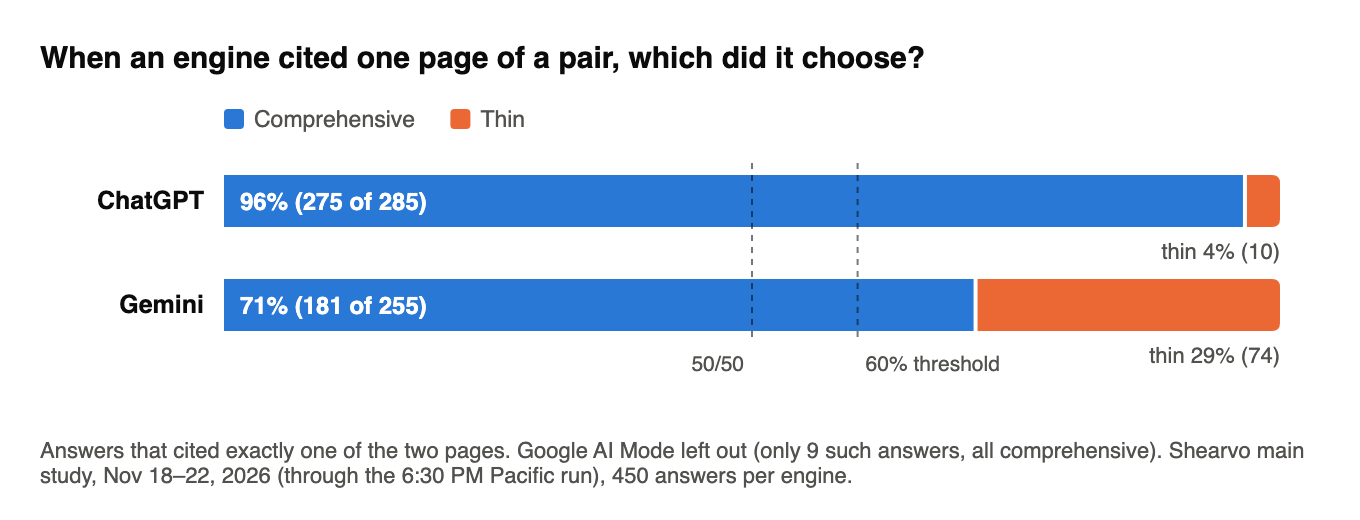
- Primary metric: Of the answers that cited exactly one page from a pair, the % that cited the comprehensive page. A page is preferred over another if citations are a minimum 60/40 split and if this result is statistically significant (p < 0.05).
Prior work
Previous studies examining what drives AI citations mostly define “comprehensive” by word count or leave it loosely defined, and their findings often contradict each other. One analysis of ChatGPT citations from Kevin Indig discovered that longer pages earned more citations, yet another study written by AirOps discovered that pages answering a query narrowly outperformed those that are more comprehensive.
Our study defines “comprehensive” by the breadth of page content rather than word count alone. A thin page answers a single question, and its comprehensive pair covers the same answer while also answering other related questions. Because each pair in our study shares a domain, title, author, and date on a fictional brand’s site, breadth becomes the main intended difference between the two pages.
Method
| Comprehensive page (treatment) | Thin page (control) | |
|---|---|---|
| What it is | Answers the query, plus answers to related questions on the same topic | Answers only the query |
| How many | 30 pages | 30 pages |
| How they were chosen | Written based on 30 distinct topics about Shearvo, which only have answers in shearvo.com. One query per topic | Same 30 topics and queries; the same answer, without the related questions |
| # of words | 95-208 | 21-54 |
| Fingerprint statistic | A statistic unique to the comprehensive page | A different statistic unique to the thin page |
| URL ending | -a or -b randomly assigned per pair | The other letter |
Website
We designed a fake brand called Shearvo (a scheduling software for shearing contractors) to create a controlled environment for our queries. A fictional company was created to minimize confounding with a pre-existing brand in our experiment, and its website was published under the domain shearvo.com, featuring a landing page, About Us, and Help Center.
Adding a fingerprint statistic to each page made it easier to tell which page an answer drew from, even if it did not cite it. Within each pair, URL letter assignment was randomized to prevent any potential bias when a search engine chooses between URL endings.
See a pair of comprehensive and thin pages here.
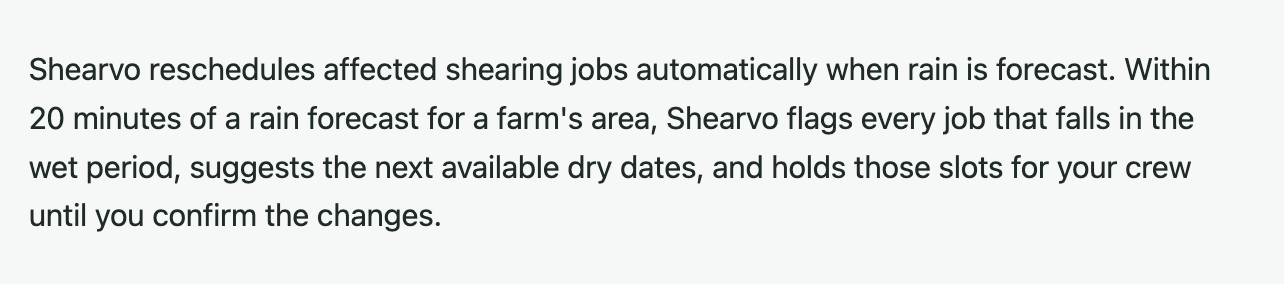

Page titles include key words for each query topic (e.g. “Tracking wool bales in Shearvo”), but are not formatted as our exact questions to simulate a more authentic help center for Google’s search engines and to create a fairer test where an engine has to match pages by meaning rather than the exact wording of page titles.
Queries
30 queries, each covering a different topic, were developed for each page pair on shearvo.com. Each query and its answer in the Help Center were drafted with LLMs. They are written to simulate real buyer questions, e.g. “Does Shearvo track shearer tallies?” If AI cited the comprehensive page, we expect to see the fingerprint statistic “12 minutes” and if citing the thin page, we expect to see “10 minutes.”
Engines
Questions were sent to ChatGPT, Gemini, and Google AI Mode 3 times a day: in the morning (8:30AM), afternoon (1:30PM), and evening (6:30PM), for a total of 270 queries per day. These engines were queried via SearchAPI to simulate results as they would appear in a real user’s web browser.
| Engine | Model | Access | Query dates | Runs per prompt |
|---|---|---|---|---|
| ChatGPT | GPT-6 | SearchAPI | Nov 18–24 | 21 (3 per day x 7 days) |
| Gemini | 3.5 Flash Lite | SearchAPI | Nov 18–24 | 21 (3 per day x 7 days) |
| Google AI Mode | Default | SearchAPI | Nov 18–24 | 21 (3 per day x 7 days) |
| Claude | Sonnet 5.5 | Claude API | Nov 18–24 (never joined) | 21 (3 per day x 7 days) |
Because Claude never demonstrated knowledge of Shearvo, we performed a reach check on Claude rather than running the full 30 queries. ChatGPT was given the same reach check during our pilot, until it was finally able to retrieve one of our pages. A reach check broadly asks “What is Shearvo?” alongside one specific query, chosen to be “How does Shearvo reschedule my shearing jobs if it rains?” None of Claude’s answers retrieved or cited a shearvo.com page, so this reach check never transitioned into the full 30 queries.
Constants
These variables were held constant in our experiment:
- Page formatting (title, author, date, template)
- Core answer within each pair
- Run dates and query frequency
- Queries sent logged out through SearchAPI
- Sent from the US, in English
Metrics
We measured the following for each response in a CSV:
- Pages cited: whether comprehensive, thin, general Shearvo page, or non-Shearvo URLs were linked.
- Pages retrieved: includes URLs an engine looked at but not necessarily cited. For Gemini and Google AI Mode, pages retrieved and pages cited are the same measure.
- Fingerprint statistic: whether comprehensive, thin, or none appeared in the answer.
- Answer quality: whether an answer hallucinated, suggested another brand, or simply could not find Shearvo. An AI grader (Claude Haiku 5.5) labeled each of these answers based on a written rubric of criteria to be classified into a category.
Pilot and main study
For 4 days (November 14 - November 17) we ran a pilot to draw exploratory insights on citations, URL retrieval, and answer quality. During the pilot:
- ChatGPT joined the experiment on November 16, after its reach check first retrieved a Shearvo URL.
- Google AI Mode was added on November 17.
- One question (Q23) did not explicitly mention Shearvo as a check to determine whether Shearvo could even be cited in a broad query about sheep shearing. All 30 queries now directly state Shearvo.
- An AI grader was developed to measure hallucinations, brand mix-ups, or being unable to find Shearvo in answers. This came after we observed several instances of fabricated details and statistics from Gemini and Google AI Mode responses.
- Gemini’s model changed from 4-Hydrogen to 3.5 Flash-Lite on November 16.
Our main study runs for 7 days (November 18 - November 24) with the same setup, plus the changes above. This article reports the first 5 days (through November 22, 6:30 PM).
We defined a page to be preferred over another if citations are a minimum 60/40 split, as well as calculating if this result is statistically significant.
Preliminary findings
| ChatGPT | Gemini | Google AI Mode | |
|---|---|---|---|
| Answers citing any Shearvo page | 98% (442 of 450) | 97% (437 of 450) | 6% (29 of 450) |
| Chose comprehensive (one page of the pair cited) | 96.5% (275 of 285) | 71.0% (181 of 255) | 100% (9 of 9) |
| Comprehensive page’s statistic in answer | 45% (204 of 450) | 31% (141 of 450) | 2% (10 of 450) |
| Thin page’s statistic in answer | 3% (12 of 450) | 19% (87 of 450) | 2% (8 of 450) |
ChatGPT strongly tends to favor comprehensive pages. When ChatGPT cited one page from a pair, it chose the comprehensive page 96.5% of the time (95% CI: 93.6-98.3%). Based on our 95% confidence interval and sample size, this preference is very unlikely to be due to chance. More importantly, the comprehensive page’s statistic was present in the answer 45% of the time as opposed to only 3% of the time for thin pages. Overall, thin pages had a 2% retrieval rate, which may point to an underlying preference for content breadth in ChatGPT’s search engine, the first stage of URL retrieval.
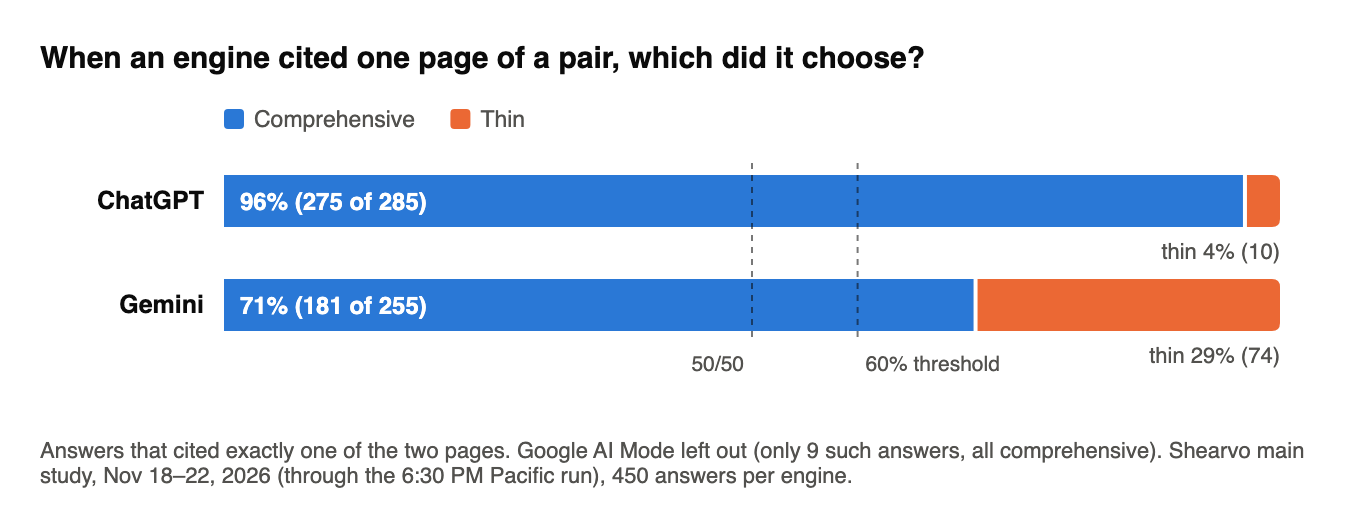
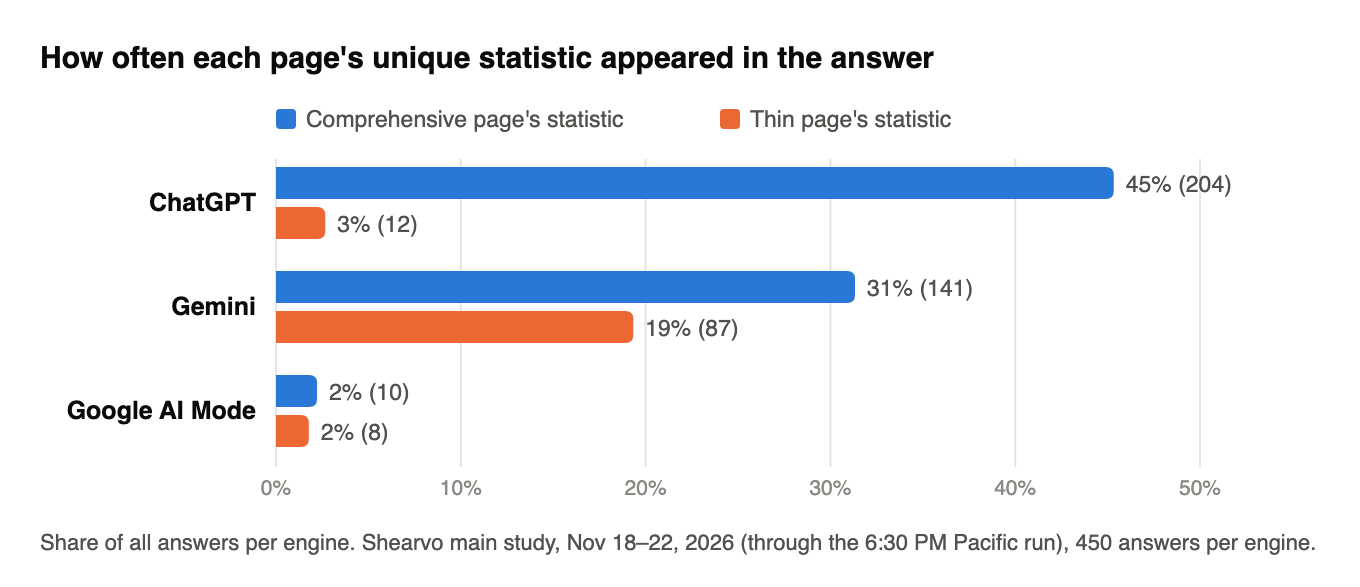
Similarly, Gemini displays a preference for comprehensive pages but struggles with producing completely factual answers. Though Gemini cited the comprehensive page 71% of the time (95% CI: 65.0-76.5%) and thin page 29% of the time, hallucinations manifested in 42% of its responses. Stating made-up statistics or product features was a tendency in several Gemini answers.
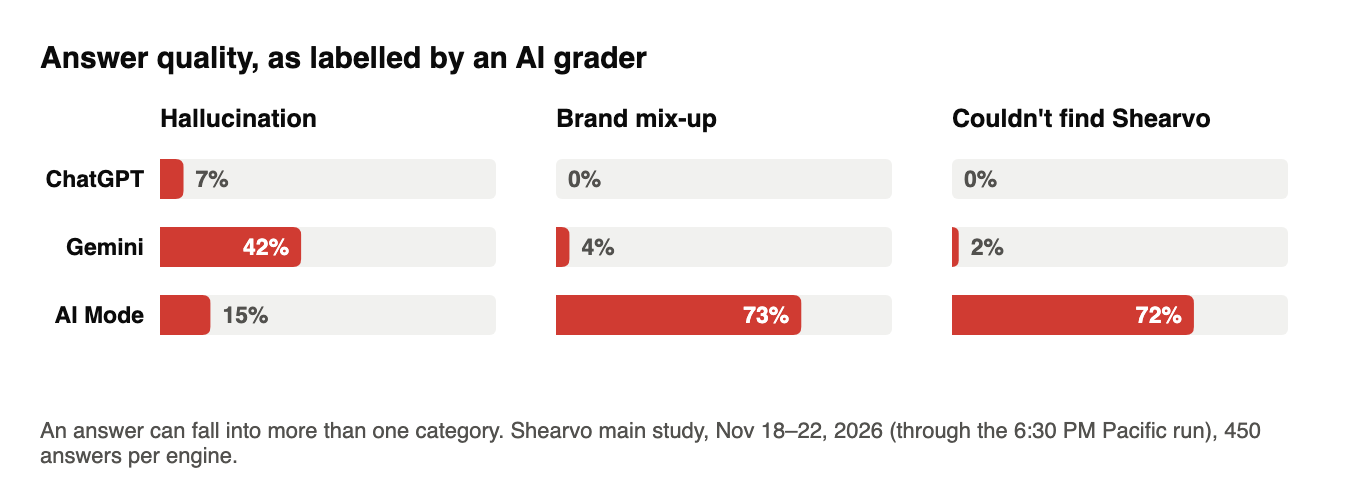
Google AI Mode showed little to no knowledge of Shearvo, even though Gemini, the engine it is built on, cited a Shearvo page in 97% of its answers. It also tends to regard Shearvo as a typo or as a brand it cannot find. Of 450 runs, the comprehensive page was cited only 9 times (2%), though the comprehensive statistic appeared 10 times (2%) in its answers. Thin pages were never cited. While AI Mode chose the comprehensive page in all 9 cases (95% CI: 66.4-100%), there were too few to meaningfully conclude a preference. Also, brand mix-ups were found in 73% of responses (e.g. “If you mean Shear Pace...”), and 72% of responses could not display any information about Shearvo.
Claude’s web search never discovered Shearvo, pointing to a potentially higher bar for newer brands to be discovered by Claude. The 23 reach checks made as of writing this article still found no trace of information on Shearvo.
Conclusions
In our experiment, ChatGPT and Gemini strongly preferred citing comprehensive pages over thinly written ones, while Google AI Mode and Claude both had trouble retrieving and citing our freshly indexed pages. These findings pertain only to the one fictional brand, Shearvo, that we created.
What does this mean for B2B marketers doing AEO?
For ChatGPT and Gemini, a page that answers a question and then covers related follow-up questions on the same page was cited far more often than those only providing a single answer. Brands may benefit from structuring their website pages into groups of related questions around one core answer instead of several single-answer questions.
This is less about length and more about covering more information on what a buyer may ask next. Still, optimizing for content breadth does not erase the need for brands to ensure company information is accurately represented. Gemini hallucinated details in 42% of its answers despite finding our pages, so brands must check what AI engines actually say about them and not solely whether they are cited.
Next steps
- Replicating this study on multiple websites, especially those that have been indexed on search engines for longer, to determine whether our findings can be generalized to all websites.
- Running full queries on Claude once it is able to retrieve any Shearvo page, and comparing its citation preferences, if any, to Gemini, ChatGPT, and Google AI Mode.
- Measuring whether the inclination toward comprehensive pages changes if Bing indexes our website.
- Capturing query fan-outs for any signs of indicating whether a comprehensive page will be preferred or not.
Caveats
- Only 9 days of data were collected (4 pilot, 5 main study) when this article was published.
- Bing never indexed our website during the study period.
- Engines, the AI grader, and one query were adjusted during the pilot (see Methods), but the main study ran with a fixed setup.
- Gemini and Google AI Mode only show the pages they cite, so “retrieved but not cited” is measured only for ChatGPT. “Retrieved” and “cited” are the same values for these two AI engines.
- Comprehensive pages are also longer than thin pages, so breadth cannot be fully separated from length when making conclusions.
Appendix
The query list, engine answers, reach checks, and grader labels are available for reference below. Responses were collected by a Python pipeline through SearchAPI and Claude API, then saved to a CSV.
Rocksalt’s Shearvo study: prompts and raw data (Nov 18–22, 2026)
This study was designed and run by Bianca Cardona, Rocksalt research intern, and reviewed by Arjun Moorthy.
Disclosure: Rocksalt builds AEO software. Shearvo is a fictional brand created for this study. No Rocksalt customers, partners, or competitors were tested in our experiment.