
Buyer Question Research and Your AI Visibility Prompt Set
A practical framework for finding what buyers really ask, choosing which prompts to track and deciding what to publish.
Introduction
Most B2B marketing teams start tracking AI search visibility by feeding their website into a prompt generator or turning a list of "best software" keywords into full sentences. Within a few weeks, they have a dashboard percentage, dozens or hundreds of tracked queries, and an uncomfortable problem: when leadership asks whether real buyers actually ask those questions, nobody on the team can prove it.
Every metric in answer engine optimization (AEO), the practice of improving how your company and expertise appear in AI-generated answers, is only as honest as the prompt set in its denominator. To build a benchmark you can defend, start with evidence from sales calls, customer conversations and community discussions rather than synthetic lists, classify prompts by the buyer's job, and stop adding queries once new candidates repeat needs you already cover.
On this page
- Why can 500 prompts tell you less than 20?
- Where should tracked prompts come from?
- How do you keep the evidence trail from transcript to prompt?
- Are buyer prompts in AI search really questions?
- Should you track recommendation and implementation prompts separately?
- Where do branded prompts fit?
- How many prompts is enough?
- How do you turn a prompt set into a content plan?
Why can 500 prompts tell you less than 20?
A prompt set's value comes from traceable coverage of distinct buyer needs, not from the total number of queries in your tracker. Twenty focused prompts grounded in real evaluation conversations can guide content and positioning decisions far better than 500 unvetted prompts whose origins nobody remembers.
We saw this pattern in a conversation with an enterprise technology company that had spent about a year tracking its full allotment of 500 prompts in Profound. The team told us it wasn't sure how relevant or useful those 500 prompts were, and that it lacked the data to judge which ones were better to track:
"I don't have that data to be like, hey, this prompt is actually a better prompt for us to be tracking."
Published recommendations vary widely: SE Ranking suggests starting with 20 to 40 prompts (and quotes growth advisor Kevin Indig's rule of roughly 15 prompts per persona) without citing data for the range, Stackmatix offers a rule-of-thumb 50 to 150 governed prompts, Profound suggests starting around 100, and Aleyda Solís proposes ranges based on business complexity in her representative prompt library framework. These figures are operating recommendations, not universal scientific thresholds.
Define what the benchmark needs to represent
Before choosing a target count or auditing an inherited list, define the boundaries of what you are measuring:
- Product, service or use case: The specific offering or workflow in scope rather than the entire company.
- ICPs and buyer roles: The job titles, company sizes and industries whose buying decisions matter.
- Problems and outcomes: The operational friction buyers are trying to fix.
- Buying decisions: The evaluation criteria, technical constraints and objections that shape shortlists.
- Countries and languages: Any regional or regulatory context that materially changes the answer.
- AI platforms: The answer engines where your buyers research the category.
"How visible is our company in AI?" is too broad to guide prompt selection. A narrower scope gives you a concrete denominator to test:
Does our company appear when security leaders at mid-market companies research how to involve employees in vulnerability remediation and evaluate products that can automate the process?
When a team already has a large prompt list like that 500-prompt set, the remedy we recommend is a comparison report that evaluates existing prompts against buyer questions mined from LinkedIn, Reddit, webinar calls and sales transcripts, sorting each query into keep, refine, discard or add.
Where should tracked prompts come from?
Prompts sourced from buyer conversations in sales calls, support channels and communities capture the operational constraints and objections buyers actually raise, whereas prompts generated from your website or an LLM mostly echo your own positioning.
In our evaluations at Rocksalt, we have found that website-generated and synthetic prompts are often "too simplistic" and "a little too terse," reusing the vendor's own language instead of modeling human behavior. As we documented in our comparison of four methods AEO tools use to generate tracking prompts, we ran into this trap ourselves when an earlier version of Rocksalt described the product as an "expert-led inbound platform," a category label we coined. A website-based tool suggested a prompt along the lines of "What are the best expert-led inbound platforms?", which reflected our own terminology rather than evidence that buyers used the category label.
Asking an LLM to brainstorm a prompt list from scratch shares the same blind spot. Conductor's enterprise AEO playbook notes that brands relying on generic LLM-generated lists or scraped browser-extension panels "aren't measuring AI visibility. They're guessing at it." Yet Conductor builds its own prompt index from organic keyword data, website content and competitor pages, leaving out the sales calls, webinar Q&As and community threads where unindexed buyer objections show up first. LLM generation is useful only as a secondary step to expand phrasing variations around needs you have already verified.
Mining real buyer discussions surfaces a different set of questions altogether. In an anonymized cybersecurity analysis conducted by Rocksalt, reviewing 61 relevant LinkedIn posts yielded 58 distinct buyer prompts and reviewing 937 Reddit posts yielded 67 prompts, which rolled up into 20 recurring buyer-need themes. Each channel contributed a different slice of buyer signal: in cybersecurity, Reddit gave a disproportionately richer conversation signal than LinkedIn, while pricing and flexibility questions surfaced in sales calls rather than online.
The table below summarizes what each of the four primary prompt-sourcing methods actually establishes and where it falls short:
| Prompt source | Evidence it provides | What it does not establish | Best use |
|---|---|---|---|
| 1. Buyer conversations (sales calls, support, Reddit, LinkedIn) | An observed concern, often with verified buyer role, stack and decision context | Population-level AI search volume or proof the exact phrasing was typed into an LLM | Core commercial benchmark and objection coverage |
| 2. SEO keyword conversion | Historical search interest in an underlying topic on Google | Demand for that conversational prompt inside AI assistants | Broad topic discovery and SEO-to-AEO alignment |
| 3. AI conversation panels | Prompts observed among a sampled panel of AI assistant users | Representative coverage of specialized B2B roles or enterprise workflows | Observing general AI query behavior where panel coverage fits |
| 4. Website or LLM generation | Plausible questions derived from your positioning or model priors | That real buyers ever ask those questions or use that terminology | Testing explicit strategic hypotheses and filling known gaps |
How teams collect community evidence is also changing as GummySearch shuts down on December 1, 2026 and Reddit ends public API access by March 2027.
Read: How to mine sales calls, Reddit and support tickets for the questions buyers ask AI
How to extract, anonymize and qualify buyer questions from sales calls, community threads and support tickets.
Read: AnswerThePublic vs AlsoAsked vs Reddit mining tools: what each finds for AEO prompt research in 2026
How autocomplete tools, People Also Ask tools, Reddit monitors and MCP workflows compare on data source, pricing and 2026 viability.
How do you keep the evidence trail from transcript to prompt?
Every tracked prompt should carry its source channel, the buyer's original words and an explicit evidence status (explicit, inferred or synthetic) so anyone on your team can audit why it is in the set. Once you separate a polished tracking prompt from the conversation that sparked it, you lose the ability to tell an authentic buyer concern from an internal guess.
Start by labeling how directly the prompt reflects what the buyer said:
- Explicit question: The buyer asked a complete, reusable question directly, such as "Can this work with our existing system, or would we need to replace it?"
- Inferred question: The question was derived from a statement, frustration or objection. When a buyer remarks that "patching always interrupts whatever the employee is doing," the implied buyer question is "How can we get employees to patch and reboot their laptops without disrupting their workday?"
- Synthetic hypothesis: The prompt was written by your team to test a strategic scenario, such as entering a new vertical, rather than observed in buyer data.
For each candidate prompt, capture eight fields before adding it to your tracker:
| Field | What to capture |
|---|---|
| Source | Sales call, customer conversation, webinar Q&A, LinkedIn, Reddit or support ticket |
| Evidence link | The specific transcript timestamp, post URL or ticket reference |
| Buyer context | Persona, company situation and ICP fit, with identifying account details stripped |
| Original language | What the buyer actually asked or said, anonymized before storage |
| Evidence status | Explicit question, inferred question or synthetic hypothesis |
| Normalized buyer need | The underlying problem, outcome, constraint or decision |
| Trackable prompt | The neutral, standalone wording that will be tested across AI engines |
| Inclusion rationale | Why the prompt deserves a slot in the benchmark |
Here is how a single remark from that cybersecurity project moves through that record to become a tracked prompt:
| Stage | Worked cybersecurity record |
|---|---|
| Buyer evidence | Paraphrased from the source: patching is invasive and interrupts whatever the employee is doing. |
| Inferred buyer question | How can employees patch and reboot their devices without disrupting their workday? |
| Trackable prompt | How can a company get employees to reboot and patch their laptops without disrupting their workday, including appropriate timing, prompts and self-scheduled reboot windows? |
| Classification | Problem Research; implementation and employee-productivity tags |
| Evidence | Six related questions from call transcripts and Reddit, including multiple sales calls |
| Why it belongs | Represents a recurring implementation constraint that affects product evaluation |
Keep two guardrails in mind when turning raw evidence into a trackable prompt. First, the evidence count (such as six related questions across calls and Reddit) is not AI prompt search volume; because AI providers do not publish query logs, it measures cross-source recurrence in the buyer evidence you reviewed. Second, keep the prompt wording neutral so it is capable of producing a disappointing result for your company. If you rewrite an employee-disruption concern into "What are the best employee-driven vulnerability remediation platforms?" just because that matches your category tagline, you are testing prompt construction rather than market visibility.
Are buyer prompts in AI search really questions?
Buyer prompts in AI search are often outcome-based requests, tasks, comparisons or constrained scenarios rather than traditional questions, so the unit worth tracking is the buyer need behind the prompt rather than its punctuation.
Survey and academic research confirm that users treat AI assistants as task and decision engines rather than simple lookup indexes. In a 2026 Semrush survey of more than 1,000 US consumers, 52% reported specifying constraints such as budget, features or use cases upfront, 53% used AI to compare products under consideration, and 33% refined their prompts through multi-turn conversation. A 2026 ACM CHI conference study proposing a taxonomy for AI-era search intent groups these interactions into three distinct modes: knowledge-seeking ("Help me understand something"), guidance-seeking ("Help me decide what to do") and output-seeking ("Give me something usable").
B2B buyers use these non-question formats to delegate evaluation work directly to the assistant. Within the same cybersecurity theme, the same underlying operational need can appear in four different prompt shapes:
- Outcome-based request: Help me reduce patching delays without disrupting employees.
- Task request: Create an evaluation checklist for an employee-led remediation workflow.
- Comparison: Compare manual and automated approaches to vulnerability follow-up.
- Scenario-based recommendation: Recommend tools for a security team using Wiz that wants to automate outreach to device owners.
When normalizing any of these prompt shapes from a longer transcript or forum thread, filter the buyer's context using two rules:
- Retain constraints that change the eligible answer: Keep details such as an existing technology stack (like Wiz or Microsoft Sentinel), regulatory requirements, company size or permission limits (such as not granting end users local admin rights) whenever they change which approach or vendor fits. Do not invent specificity merely to make a prompt sound realistic.
- Remove private and incidental details: Strip customer names, employee names and confidential infrastructure details before storing or testing the prompt, replacing them with the minimum context required to preserve the buyer's decision.
Should you track recommendation and implementation prompts separately?
Unbranded Problem Research prompts and Vendor Recommendation prompts measure different commercial outcomes and should be tracked and reported separately, with implementation applied as a cross-cutting tag on both because B2B buyers evaluate implementation risk long before they buy.
Splitting unbranded prompts by the buyer's job clarifies what a win actually looks like in each group:
- Problem Research prompts help buyers diagnose an operational issue, weigh approaches, overcome a workflow constraint, judge deployment difficulty or build an internal business case (for example, "How can we reduce alert-tuning work without weakening detection coverage?" or "What normally goes wrong when vulnerability remediation depends on end users?"). Here, the primary outcome to measure is whether your content is cited and whether your expertise is represented accurately. Broad definitional queries such as "What is vulnerability management?" make poor tracking prompts because buyer context rarely changes the answer.
- Vendor Recommendation prompts ask directly or indirectly which companies, products or services fit a defined need (for example, "Which tools can automate outreach to device owners after Wiz finds a vulnerability?" or "What products support employee-led remediation without giving users administrative access?"). Here, brand inclusion and recommendation are the primary outcomes, alongside the sources the engine cites to justify its shortlist.
Treating recommendation prompts as mid-funnel discovery and implementation prompts strictly as post-purchase setup misreads B2B buying behavior. Enterprise and mid-market buyers ask implementation-risk questions while they are still deciding which approach or vendor can work in their environment.
Treating implementation as a stage or subject tag rather than a separate post-purchase silo lets you see where deployment concerns intersect with both research and vendor selection:
| Prompt | Primary category | Additional tag |
|---|---|---|
| How disruptive is employee-led patching to deploy? | Problem Research | Implementation and evaluation |
| Which remediation products integrate with Wiz? | Vendor Recommendation | Implementation and integration |
| How do I configure a feature in Product X? | Branded support | Post-purchase |
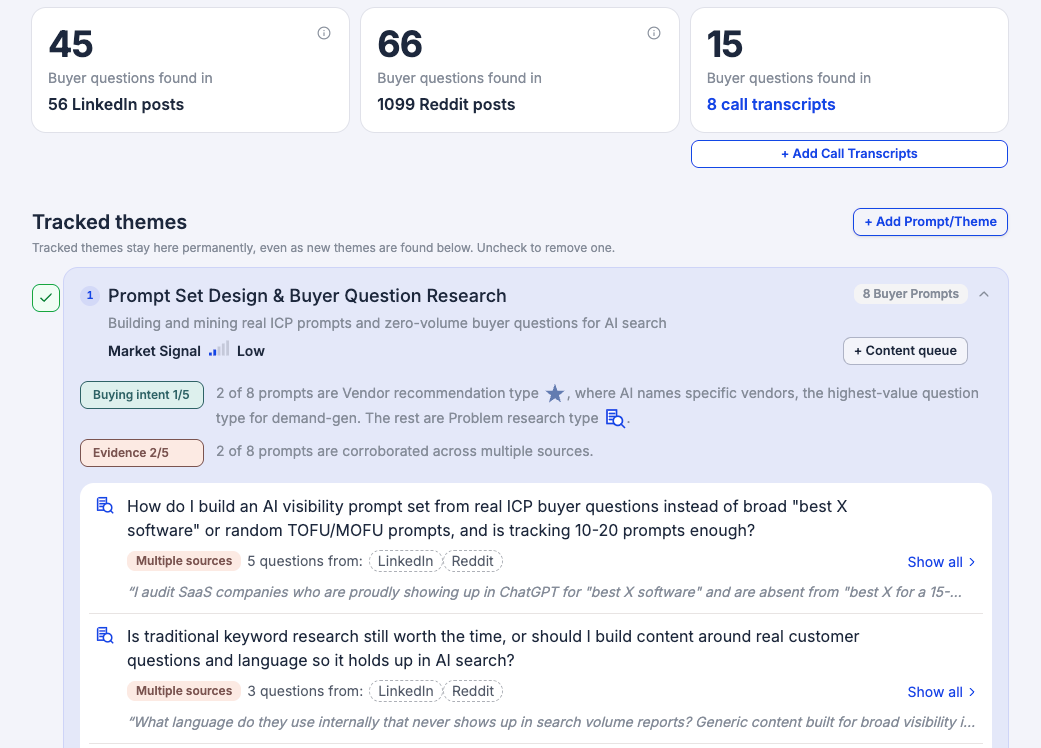
Grouping prompts under buyer-need themes keeps those relationships visible. In Rocksalt's anonymized cybersecurity project, eight tracked prompts sat beneath the Employee-Driven Vulnerability Remediation theme: five represented Problem Research, three represented Vendor Recommendation, and seven of the eight were corroborated across multiple sources, including sales calls.
Because a single aggregate visibility score (such as "52% visibility" or "26% sentiment") felt "vanity-ish" to our team, Rocksalt breaks reporting down by buyer journey stage (awareness, research, decision), by brand mention versus citation, by AI engine and by theme.
That split can change the story a dashboard tells. For one IT customer, visibility on Vendor Recommendation prompts was 33.6% across ChatGPT, Google Gemini and Google AI Overviews, while its citation rate on Problem Research prompts was just 2.5%. The company shows up when buyers ask which vendors to consider, but it may not be influencing them earlier, while they're still researching the problem. Blended into one score, that gap disappears.
Where do branded prompts fit?
Branded prompts answer a different question from category discovery: how AI engines describe and position your company once a buyer already knows your name. No published evidence supports a fixed branded share, so let buyer evidence decide which branded prompts you track, and keep them out of your mention-rate math.
Published vendor guides handle branded prompts differently and cite no empirical data for a fixed ratio. OptimizeGEO's planning documentation prescribes an 85% to 90% non-branded and 10% to 15% branded split as a fixed rule, whereas SE Ranking recommends tracking 5 to 10 brand evaluation prompts in a separate group altogether. As SE Ranking notes, when your brand name is in the prompt, an AI mention is nearly guaranteed, which inflates category-level metrics if the two groups are mixed.
Instead of managing to a percentage split, track a branded prompt when buyers actually ask it, and file it under the buyer-need theme it belongs to, as you would an unbranded one. That's how we handle it at Rocksalt: branded buyer questions we surface go into their themes rather than a separate quota. Because a prompt that names your company will almost always mention it, report mention rates with branded prompts filtered out rather than blended in. Branded prompts earn their place by auditing accuracy, positioning and competitive framing across four types of buyer checks:
- Named competitor comparisons: Prompts such as "Brand A vs. Competitor B for mid-market security teams" reveal which strengths, weaknesses and third-party sources engines associate with each vendor.
- Pricing and packaging questions: Prompts such as "How does Brand A pricing work, and what is included in the base tier?" catch hallucinated pricing models or outdated contract terms.
- Company-fit validation: Prompts such as "Is Brand A right for a 200-person company using Microsoft Sentinel?" test whether AI assistants accurately describe your ideal customer profile and disqualifiers.
- Branded support and configuration: Post-purchase tagged prompts such as "How do I configure self-scheduled reboot windows in Brand A?" verify whether engines retrieve and cite your technical documentation accurately.
How many prompts is enough?
Ten to twenty prompts suit a narrow diagnostic for one ICP and use case, roughly 50 cover a single product across several buyer roles or modules, and 100 or more fit a modular multi-product program, and your set is large enough when the next five to ten candidates only reword buyer needs you already track.
Treat published numbers such as SE Ranking's 20 to 40, Stackmatix's 50 to 150 or Profound's ~100 as operating recommendations tied to team capacity and scope rather than statistical thresholds. Each set size carries clear boundaries on what it can and cannot prove:
| Prompt count | A reasonable use | What the number does not prove |
|---|---|---|
| 10 to 20 | A narrow diagnostic for one ICP, one use case and a few high-priority buyer needs | Category-wide visibility or coverage of a complex multi-stakeholder buying journey |
| 50 (or 30 to 50) | Broader coverage for one product across several related personas, integrations or modules | Representative market visibility if the prompts repeat the same underlying question |
| 100 plus | A modular program spanning multiple products, markets, personas or competitor segments | Better insight if the additional prompts lack buyer evidence or clear actionability |
Deduplicate before you count, and apply the stopping test
Before expanding a set to hit a target number, remove superficial phrasing duplicates. "What is the best vulnerability-remediation tool?" and "Which vulnerability-remediation tool is best?" represent one buyer need, not two. Keep a prompt variation only when the difference could plausibly change at least one of four things:
- The buyer's decision
- The eligible approaches or vendors
- The substantive answer or the sources cited
- The action your team would take after seeing the result
To check whether your set is large enough for its defined scope, review the next five to ten candidate prompts from your evidence pool. If most introduce only a wording change rather than a new buyer need, constraint, persona or buying stage, stop adding to the core set. Also exclude real remarks that come from outside your ICP, depend on confidential single-account context, rest on an obsolete product premise, or were introduced by the salesperson rather than the buyer.
Separate prompt breadth from run frequency and exploration
Expanding your prompt list and running each prompt repeatedly solve two different problems. More prompts broaden the buyer situations you represent; repeated runs account for output variance across sessions (in SE Ranking's local AI Mode study, only 35% of cited domains repeated across runs, while two-thirds vanished between runs). Neither substitutes for the other.
To keep longitudinal trends clean without ignoring new market language, split your unbranded prompts into two layers:
- Core benchmark: A stable, versioned set representing your highest-priority buyer needs, kept unchanged across a defined measurement cycle so visibility shifts reflect model or market movement rather than prompt edits.
- Exploratory set: A rotating group for emerging buyer questions, new competitor pairings and strategic synthetic hypotheses. Promote an exploratory prompt into the next versioned core benchmark only when it fills a verified coverage gap and produces findings your team can act on.
How do you turn a prompt set into a content plan?
The same two dimensions that determine which prompts belong in your core tracking benchmark, commercial relevance crossed with independent evidence strength, also decide which buyer questions your team should publish content to answer.
Evaluating candidate questions on both axes reconciles the debate between teams that only publish verbatim customer quotes and teams that filter large keyword exports:
- Commercial relevance weighs whether the question concerns a problem your company solves, surfaces a requirement or objection that shapes shortlists, and sits where your internal subject-matter experts have a distinct angle to offer.
- Evidence strength weighs how many independent buyers express the need, whether it recurs across channels (especially sales calls alongside Reddit or LinkedIn), and whether the speakers fit your ICP. Six comments from one vocal participant in a forum thread do not equal six independent buyers.
| Commercial relevance vs. evidence | Stronger evidence (recurs across calls and communities) | Weaker evidence (isolated remark or single source) |
|---|---|---|
| Higher commercial relevance | Prioritize: Add to the core benchmark and build or update content first | Review: Include in exploration or publish if raised by a strategic account |
| Lower commercial relevance | Include selectively: Cover only if it supports an important problem-research theme | Exclude: Drop from both tracking and the content roadmap |
Rather than publishing a standalone article for every prompt variation, Rocksalt organizes buyer intelligence in a hierarchy from granular prompt to buyer question to theme. For each priority theme, we recommend building one comprehensive pillar page linked to roughly six interlinked subpages, one per underlying buyer question, with H1 and H2 headings that match the questions buyers actually ask, then refreshing the theme data monthly to see which questions persist and which new ones appear.
Read: Keyword volume, Google Trends or buyer evidence: which demand signal should drive AEO content?
How keyword volume, Google Trends and cross-source buyer recurrence compare when deciding what to publish for AEO.
Read: From not cited to published: finding the sub-questions AI answers and choosing which to write
How to map buyer follow-up questions to AI sub-queries and turn visibility gaps into updated pages or theme clusters.
Build the smallest defensible set, not the longest list
A trustworthy AI visibility benchmark is not a contest to track the most prompts. It is a disciplined sample of the buyer situations your company needs to understand and influence, built so that every metric on your dashboard traces back to real people describing real problems.
When you preserve the link between each polished prompt and the sales call or forum thread behind it, separate Problem Research citations from Vendor Recommendation inclusions and branded checks, and stop adding queries once new candidates repeat covered needs, your reporting stops being a vanity score and becomes an editorial roadmap.
Before any prompt enters your core benchmark, ask four questions: Which buyer does this represent, what are they trying to understand or decide, what evidence supports it, and what new coverage does it add? If you can answer all four, your prompt set will tell you what your market actually cares about and where your expertise needs to show up next.
How Rocksalt helps teams build prompt sets from buyer questions
Rocksalt surfaces buyer questions from Reddit, LinkedIn and sales-call transcripts. When a transcript is uploaded, pattern matching removes identifying details before an LLM extracts question-and-answer pairs, and the transcript is then deleted. Rocksalt groups the extracted questions into themes, scores themes on commercial intent, question depth and source breadth, and, once a customer connects their CMS, checks those themes against what is live on their site. When content needs first-hand input, internal experts answer questions by email or through inline comments.
Sources
- SE Ranking, "How to Choose Prompts to Track"
- Stackmatix, "AEO Prompt Management"
- Aleyda Solís, "AI Search Prompt Library"
- Conductor, "AI Prompt Generation for AEO"
- ACM CHI Conference, "A New Taxonomy of Web Search: A User-Centered Framework for Search Intent in the AI Era" (2026)
- OptimizeGEO, "Topics and Prompts Planning"
- GummySearch, "GummySearch Is Now Closed" (2026)
- TechCrunch, "Reddit Is Killing RSS Feeds, Ending Public API Access Because of AI Bots" (2026)