Prompt Discovery
AI cites the page that answers the buyer's exact question. So start with the real question.
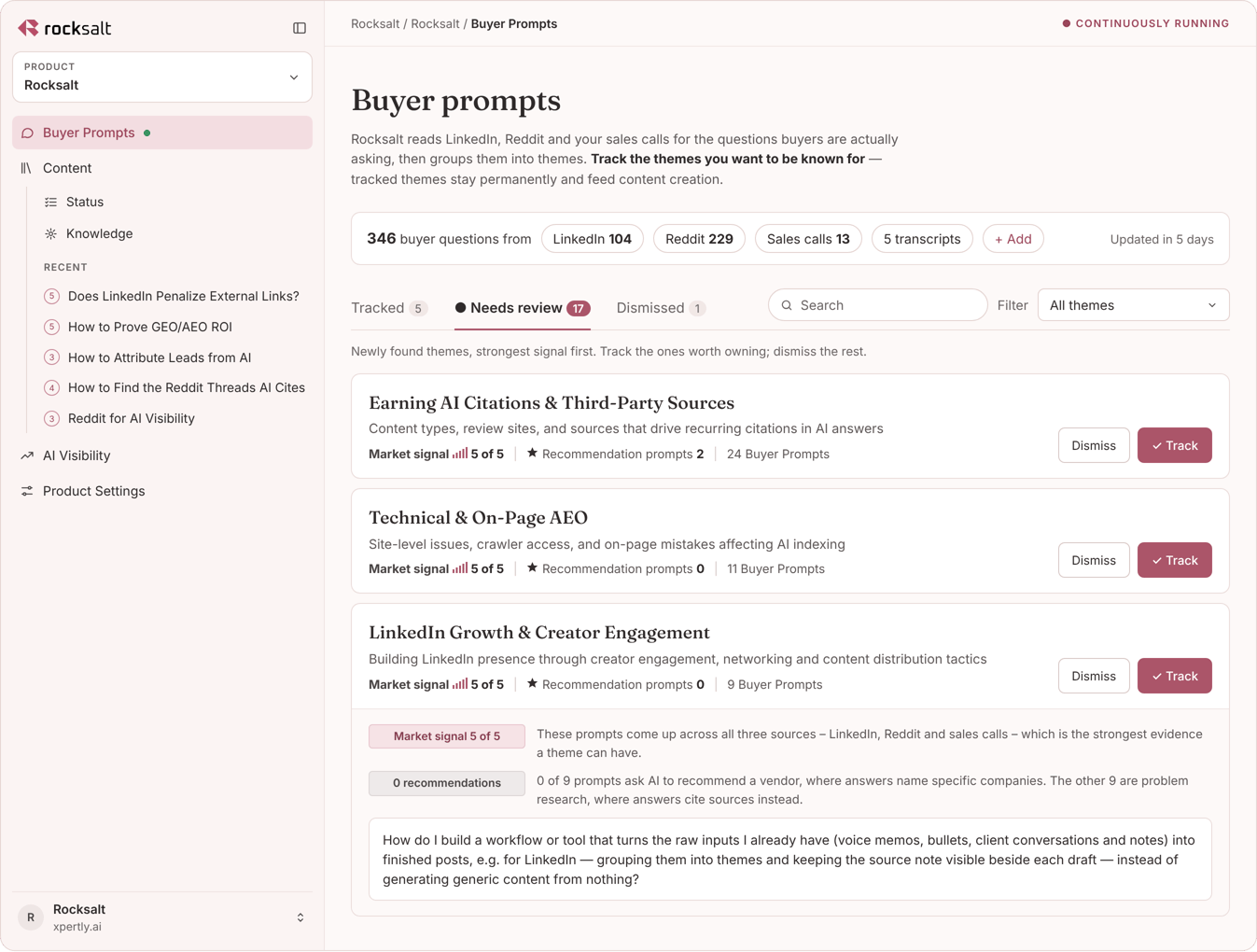
Buyers don't type keywords into AI. They ask long, specific questions, and AI cites the pages that match them most closely. Rocksalt finds those questions where buyers actually ask them: LinkedIn, Reddit, your sales calls and support tickets. It scores each one for market signal and buying intent, then groups them into themes you can own.
Why real questions matter
The question you track decides what gets cited
If you track prompts nobody types, you optimize content nobody's question will retrieve. Rocksalt's own data shows its prompts match how buyers really ask, and independent research shows why that matters.
Finding 01 · Rocksalt data
Rocksalt prompts are as long as the questions buyers really ask
Buyer prompts found by Rocksalt average 23 words. That's the same as the average real ChatGPT prompt in Semrush's analysis of 80 million clickstream records.1
Prompt lists built from keywords start from short search phrases. Rocksalt starts from questions buyers actually asked, so it tracks them the way buyers phrase them.
Rocksalt analysis, November 2026. Average length of buyer prompts surfaced by Rocksalt.
23
words on average in a buyer prompt found by Rocksalt
23
words on average in a real ChatGPT prompt1
Finding 02
Relevance to the question decides who gets cited
ChatGPT retrieves dozens of pages per answer but cites only about half of them. In Ahrefs' study of 1.4 million prompts, the cited pages had titles measurably closer in meaning to what the user asked.2
Title-to-prompt semantic similarity (cosine), Ahrefs, April 2026
Match the question, earn the citation. The closer your page is to the way buyers actually word their questions, the better its chance of being the one AI cites.
Finding 03
Most real prompts never show up in a keyword tool
Kevin Indig highlights in Growth Memo that 65–85% of ChatGPT prompts have no matching keyword in Semrush's database.3 He also points to AirOps data showing 95% of the follow-up searches ChatGPT runs behind the scenes had zero monthly search volume.4
65–85%
of ChatGPT prompts have no matching keyword
95%
of ChatGPT's background searches had zero search volume
Keyword data starts in the wrong place. A prompt list built from search volume can't contain the questions that have no volume, and that's most of what buyers ask AI.
A generated prompt · 6 words
“best AI content tools for LinkedIn”
A question a buyer actually asked · 38 words
“How do I build a workflow that turns the raw inputs I already have — voice memos, bullets, client conversations — into finished LinkedIn posts, keeping the source note visible beside each draft, instead of generating generic content from nothing?”
Optimize for the first and you can still miss the second. The second is what your buyer typed.
How Prompt Discovery works
From what buyers say to the prompts worth winning
01
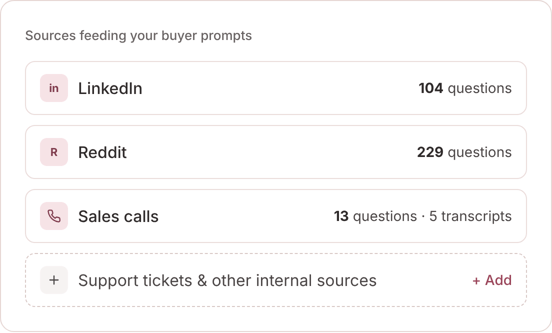
Start where buyers actually talk
Rocksalt reads the questions buyers ask in public on LinkedIn and Reddit, and in private on your sales calls and support tickets.
Public channels show what the market is asking. Internal sources show what your own buyers ask right before they buy.
02
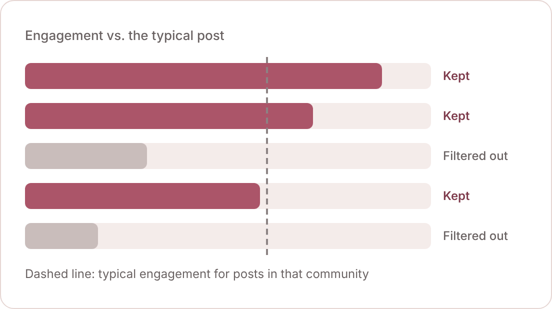
Keep only the questions the market responded to
Not every post is a signal. On Reddit and LinkedIn, a question only makes the cut if it earns more engagement than posts in that space typically get. One-off chatters fall away. What's left are the questions other buyers recognized as their own.
03
Prioritize by market signal and by money
Two scores tell you what to win first.
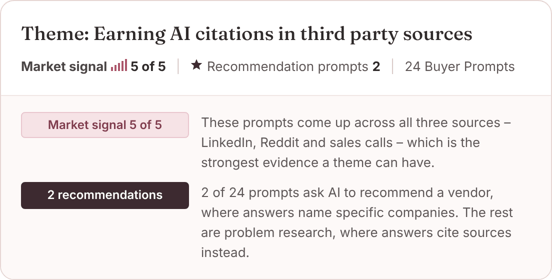
Market signal (1–5). A question that shows up across several sources, or again and again in your calls, is stronger evidence than one heard once in one channel.
Recommendation prompts. Money questions, where a buyer asks AI to recommend or compare vendors, get answers that name companies. Early research questions get answers that cite sources. Both matter; the money questions come first.
04
See themes, not just a pile of prompts
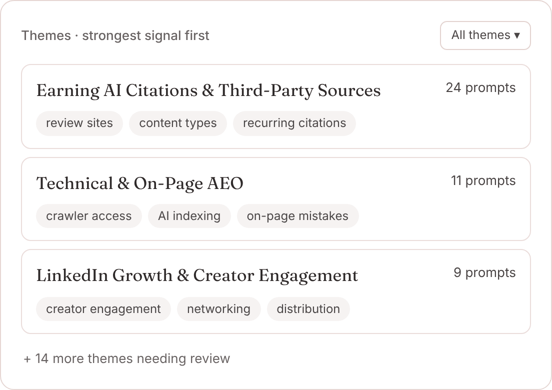
Rocksalt clusters related questions into themes, so you can see the patterns in what your market cares about. Your content and AEO strategy runs at the level of themes you want to own, instead of chasing one tactical prompt at a time.
You can also add themes that you want to be known for. Rocksalt starts tracking questions related to that topic.
The difference
Generated prompt lists vs. Rocksalt Prompt Discovery
| Typical AEO tool | Rocksalt | |
|---|---|---|
| Where prompts come from | An LLM reads your website, or prompts are built from keyword volume | Real questions from LinkedIn, Reddit, sales calls and support tickets |
| What they look like | Short, keyword-style | The buyer's own words, 23 words on average |
| Quality filter | Volume for keywords | Public questions must beat typical engagement for their community |
| Prioritization | Every prompt treated equally | Market signal plus recommendation (money) prompts first |
| Evidence | Hard to trace | Every question linked to its source |
| Freshness | Set once, ages quickly | Continuously running; new questions surface as buyers ask them |
“I knew our prompts weren't realistic but didn't know how to correct that. Rocksalt showed me what buyers actually ask.”
CMO, 500-person company
FAQ
Questions about Prompt Discovery
How is this different from the prompts in my AEO tracking tool?
Most tracking tools generate prompts by having an LLM read your website or by converting keywords into questions. Rocksalt starts from questions buyers have actually asked, so you track what your market types, not what a model imagined.
How long are Rocksalt's prompts?
Rocksalt buyer prompts average 23 words, because they come from questions buyers actually asked. That matches the average length of a real ChatGPT prompt.
Which sources does Rocksalt read?
Public conversations on LinkedIn and Reddit, plus your internal sources such as sales call transcripts and support tickets.
What does market signal mean?
It scores how strong the evidence is for a theme, from 1 to 5. Questions seen across multiple channels, or repeatedly in your calls, score higher than questions seen once in one place.
What is a recommendation prompt?
A question where the buyer asks AI to recommend or compare vendors. AI answers to these name specific companies, which makes them the highest-value prompts to win.
Can I track a topic Rocksalt didn't surface?
Yes. Add any theme you want to be known for and Rocksalt scans all connected sources for real buyer questions about it.
What happens after I track a theme?
Tracked themes stay permanently. They drive your AI visibility tracking and feed content creation, where Rocksalt drafts original content from what your company knows.
Stop guessing prompts. Start with what buyers ask.
See the buyer questions Rocksalt finds for your company, and which ones are worth winning first.
Sources
- Semrush, “New Semrush Study Reveals ChatGPT Search Trends: Insights from 80 Million Clickstream Records,” February 2025.
- Ahrefs, Louise Linehan, “Why ChatGPT Cites One Page Over Another (Study of 1.4M Prompts),” April 2026.
- Kevin Indig, Growth Memo, “Growth Intelligence Brief #17,” April 2026 (citing Semrush clickstream data). growth-memo.com
- Kevin Indig, Growth Memo, “Growth Intelligence Brief #16” (citing AirOps analysis of 15,000 prompts). growth-memo.com